

Enterprises deploying AI today are quickly realizing that the future isn't renting a general-purpose frontier model that every competitor can rent. It's owning smaller, specialist models trained on your organization's data, cheap to run and impossible to copy. The hard part isn't knowing this. It's the how. How do you move from a stack built entirely on rented intelligence to one you own, without breaking what already works?
We've been in the engine rooms of enterprises helping them deploy AI at scale and move beyond the frontier to owned models. We've codified this tradecraft into toolkits that make up the Hyde platform.
We think this will be a constant migration that enterprises will go through for every use-case. Why? It comes down to the two costs of staying on rented intelligence, and both compound the longer you wait. The first is visible and immediate: the compute bill. The second is invisible and far more damaging over the long run: the steady erosion of the proprietary know-how that creates your competitive advantage. One is the cost of today. The other is the cost of tomorrow, your moat.
The cost of today
Eighteen months ago, the winning agent architecture was to route everything through the biggest, smartest model you could get your hands on. A trillion-parameter generalist model that could reason its way through anything and top every benchmark. It worked. But it was also the most expensive way imaginable to answer a question the organization had already answered a thousand times. It’s clear now that the scaling economics of these agents are broken: compute spends increase disproportionately even as the underlying token costs drop.
.png)
The reason for this divergence in per token cost and enterprise AI bills is a structural issue. Agentic flows built on generic frontier models re-derive solutions from scratch for tasks your team has solved a thousand times over. They repeat the same mistakes and trigger correction and retry loops that each cost tokens and engineering time. Multiply this across fifty or hundred members, each running longer and longer agentic sessions, and this hidden structural cost blows out.
The priority for CTOs today is Return on Token (‘ROT’). It is not about getting the most work out of a generalist frontier reasoning model. It's about being diligent and precise in picking the right-sized model for your needs. It's about training a far more cost efficient and precise model, custom to your high-frequency, high-value workflows. The focus is ROT, and the way to maximize it is by owning your intelligence.
The cost of tomorrow, your moat
This is the cost that never shows up on a budget line, and it compounds quietly.
An organization's lasting advantage is in its intellectual property and tribal knowledge - the particular way it solves its problems, and almost none of it is written down anywhere. It lives in scattered configuration, in comments on old pull requests, buried in code repositories over the years, and in the memory of your longest-tenured employees. Every time your teams run that knowledge through a rented frontier model, your proprietary intelligence gets distilled away and carried off to someone else's system.
Our conviction has been that the next era of enterprise AI would be small, owned, and specialized, and that the winners would be the ones who controlled their own intelligence instead of renting someone else's. We’ve partnered with enterprises to do exactly that, to retain their hard-won knowledge in the form of specialist models they own.
Alex Karp and Satya Nadella have supported this hypothesis recently. In the July 2026 essay on the “Reverse Information Paradox”, Satya argues that when you use a rented model you pay for intelligence twice, once in money and again in the proprietary knowledge you must reveal to use it. That this intelligence exhaust leaks trace by trace, correction by correction, eval by eval toward whoever owns the model. This unidirectional flow and leakage of intelligence is something that every board discusses today.
A rented frontier model or self-hosted open-weights model gives you the same outputs your competitor gets. There's no edge in a tool everyone can buy. The real moat is how your organization works, captured in a form that compounds: an asset that grows with every session. Enterprises who bank this asset as private skills and evals to build their own specialist models gain asymmetric advantage.
The time to start thinking about how you accrue intelligence is now.
The path to owned intelligence
Deploying specialist models alongside enterprises, we have learned what’s actually difficult. You don't wake up one morning and train a model on “your company.” Because before you can train a model on how your organization works, you must know how your organization works, at the resolution a model needs. Where exactly are your tokens going? Which workflows repeat a thousand times a week? Which agents need a specialist model and where is generalist reasoning required? What is your unique definition of baseline intelligence? For almost every enterprise we've talked to, the spend is visible but the shape of the spend is invisible.
This is why jumping directly to building a specialist model is risky, and why most enterprises have no safe path there today. They cannot see how work is distributed across models or where the cost goes. They have no ground-truth evals to prove a smaller model is good enough. And routing across models is manual and ad hoc, with no system or policy deciding what runs where. That gap is the first hill to climb. So, we built the tool that climbs it.
.png)
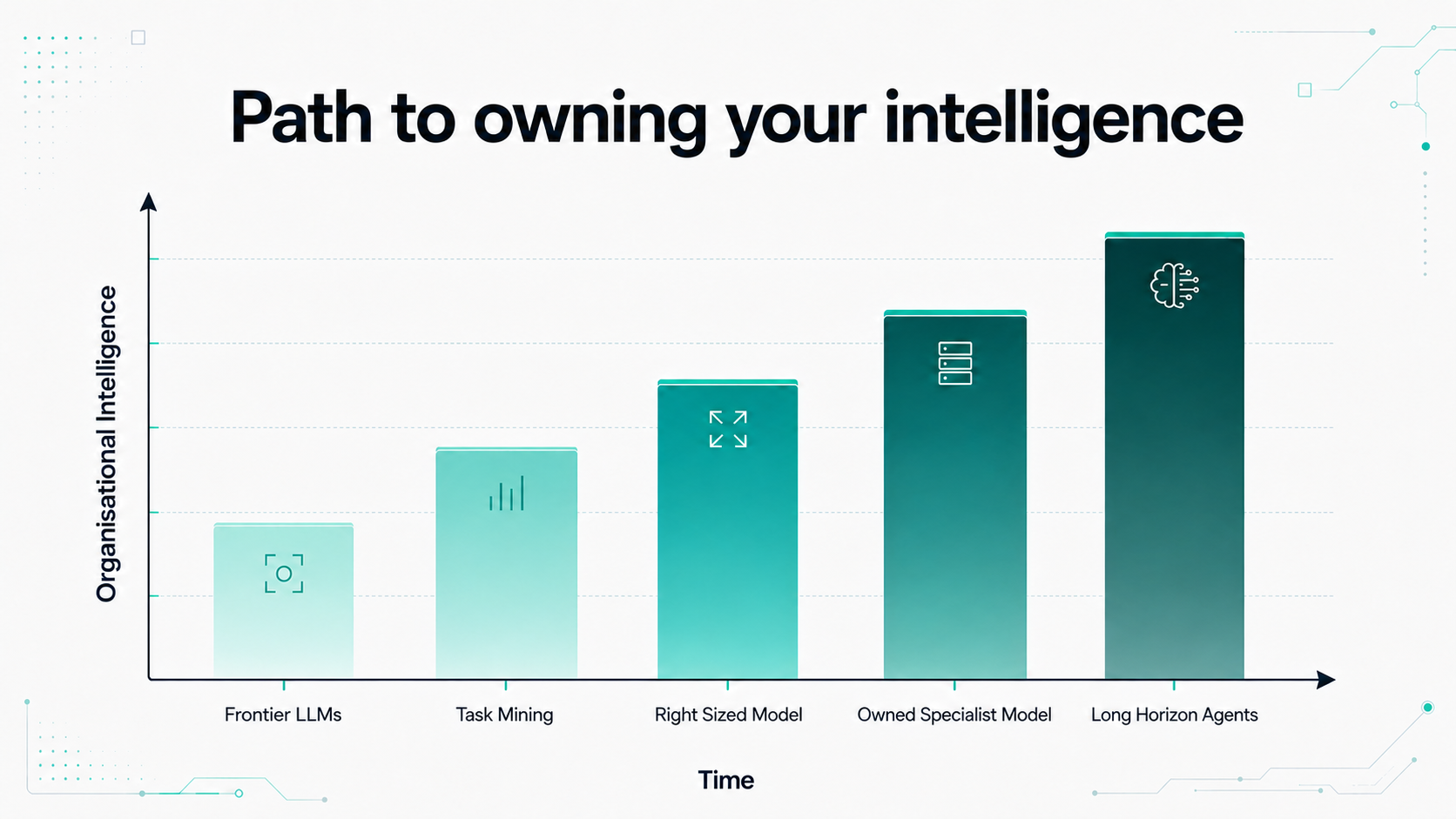
It begins by using Hyde’s “Refinery” to mine traces: observe, capture and cluster real model usage into workflows, skills, and extract tasks, so you finally see where your tokens are going. From there you measure and build golden data sets, evals and benchmarks from SoTA model outputs along with SME labeling and AI experts to prove quality per workflow. With that baseline in place, you route to smaller models, incrementally migrating each workflow to the smallest capable model while tracking regression against benchmarks. And finally, using Hyde’s “Campfire”, build the specialist precision model itself.
Refinery is where the migration begins, and it is fast to stand up. We deploy the SDK in under 48 hours, and most enterprises see a significant drop in token spend within the first two weeks, well before a single specialist model is trained.
But observability is only the first step. The traces Refinery captures become the benchmarks, evals, and skills that route your work to the smallest capable model. From there, Campfire turns that same signal from the training data into purpose-built specialist models leveraging DPO and GRPO. These specialist models become your real moat. Together they are the full arc of the migration: Refinery to see and keep your intelligence, Campfire to compound it.
